
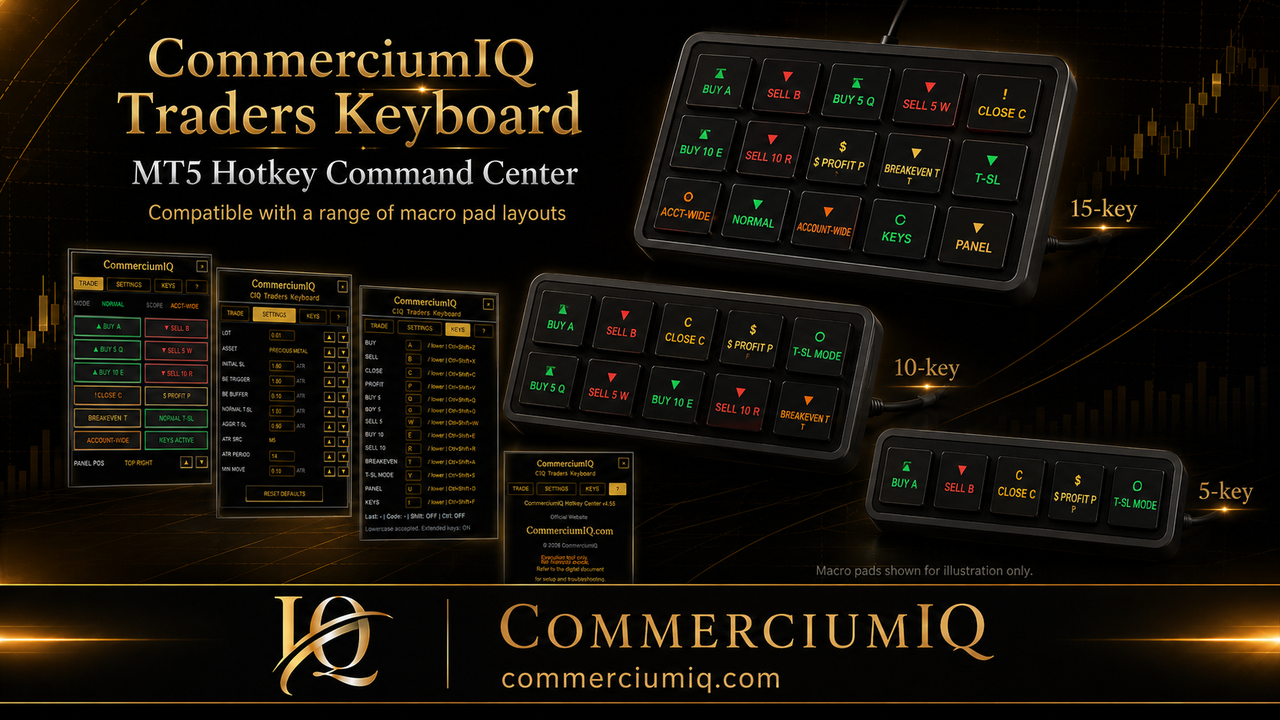
Key point
An MT5 execution workflow is the repeatable sequence between a trader's manual decision and the platform result the trader verifies afterward.
It includes context checks, command selection, input method, after-state review, and correction if the result does not match the trader's expectation.
Execution workflow is not a strategy
A workflow does not decide whether the trade idea is valid. It does not predict price, choose direction, place trades automatically, or remove market risk.
The workflow begins after the trader has made a manual decision and needs a controlled way to carry out a selected platform action.
Start with the trading decision
The first step is the user's decision. That decision may come from a plan, chart review, risk rule, or trade-management routine, but it should exist before the command is triggered.
A hotkey should not create the decision. It should help carry out a decision the user already understands.
Confirm platform context
Platform context includes account mode, active chart, broker symbol, position list, and whether an existing trade is open. These details determine what the next command can affect.
A workflow that ignores context is incomplete. The same key can feel familiar while the active MT5 environment has changed.
Choose the command deliberately
The trader should name the command before using it. Entry, close, protection, partial-close, utility, and mapping commands belong to different command families.
Naming the command creates a short moment of review. That matters because a fast input can otherwise become a reflex without enough context.
Choose the input method
The input method may be a mouse click, keyboard shortcut, macro pad key, or software panel button. The method should match the importance of the action.
Some commands deserve fast access only after they have been tested. Others may be safer when left to a slower manual path.
Verify the after-state
The workflow is not complete when the key is pressed. It is complete when the trader verifies the result in MT5.
The after-state should show whether a position opened, closed, changed protection, remained unchanged, or generated a platform message. This confirmation step catches unexpected behavior before the trader repeats the command.
Use demo testing to prove the sequence
Demo testing lets the trader practice the whole workflow without relying on assumptions. The user can write the expected result, run the command, and compare the actual platform state.
A proven workflow is easier to support, easier to document, and easier to rebuild after MT5, broker, or product changes.
Document the workflow
A simple workflow note can include account type, broker symbol, command name, input method, expected result, and any platform message.
This note is not busywork. It becomes a practical reference when the user changes devices, reinstalls MT5, updates the software, or asks for support.
Where CIQ Traders Keyboard fits
CIQ Traders Keyboard fits in the input and command-access part of the workflow. It can make selected commands easier to reach and easier to organize.
It does not replace the user's trading plan, broker execution, market judgment, or responsibility to confirm context before action.
Avoid confusing speed with quality
A faster execution workflow can reduce repeated steps, but it does not guarantee better trades. A poor decision can still be executed quickly.
The useful goal is operational clarity: fewer avoidable mistakes, clearer command boundaries, and tested platform behavior.
Know the workflow boundaries
CIQ Traders Keyboard supports manual command access and workflow organization. It does not select trades, predict markets, provide signals, or operate as a trading robot.
You remain responsible for the trading decision, platform checks, command choice, risk settings, and verification of the MT5 result.
Final workflow rule
The final rule is to treat MT5 execution as a sequence: decide, check context, choose command, choose input method, trigger once, verify result, and record problems.
That sequence makes hotkeys and macro pads part of a disciplined manual workflow rather than a source of hidden risk.
Execution workflow example sequence
A simple execution workflow can be written as: decide, confirm platform context, choose the command, choose the input method, trigger once, verify the platform result, and record anything unexpected.
This sequence makes it clear that the hotkey or macro pad is only one part of the workflow. The user still controls the decision, checks the active MT5 context, and confirms the result after the command.
That is the difference between a disciplined workflow and a hidden automation assumption.
What to record for support
Record the account type, broker symbol, command name, input method, expected result, and actual result shown in MT5.
Those facts help separate a product setup question from broker execution, platform focus, device profile, or user decision-making.
The software supports workflow organization but does not control market outcomes.
A full execution workflow example
A complete manual execution workflow might start with a chart decision, then move to an account check, symbol check, position-size check, and command selection. Only after those steps does the trader choose whether to use a mouse, keyboard shortcut, macro pad key, or software panel button.
The workflow ends with a verification step. The trader reads the MT5 terminal to confirm whether the command opened a position, closed one, moved protection, or produced an error message.
This sequence makes the shortcut part of a controlled process instead of treating the shortcut as the process.
What belongs outside the workflow
Trade selection, market prediction, emotional discipline, and risk appetite belong outside the execution tool itself. A workflow can help the trader carry out a chosen action, but it cannot decide whether the action should be taken.
CIQ Traders Keyboard is software workflow support, not a signal engine, trading robot, market-prediction service, or profit system.
Keeping that boundary clear reduces unrealistic expectations and keeps the trader responsible for every decision.
Map your own MT5 process
Write down the decision point, platform checks, command name, input method, and result you expect to see in MT5.
Once the process is clear, decide which steps deserve faster access and which steps should remain slower and more deliberate.
When the workflow should pause
The workflow should pause whenever the active account is unclear, the broker symbol does not match the expected chart, the position list looks different from memory, or the command result cannot be predicted.
Pausing is not a weakness. It is the control mechanism that keeps fast input from becoming careless input.