
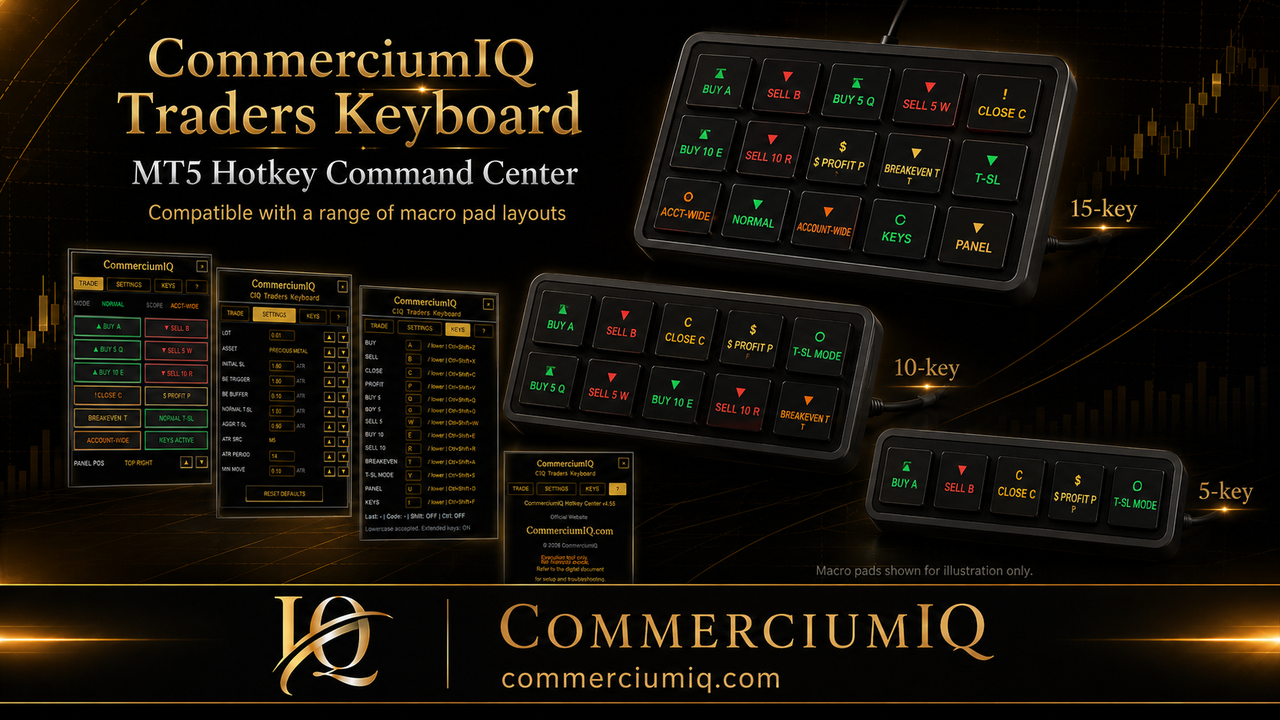
Key point
A trading hotkey workflow is the repeatable process a trader uses to reach execution and trade-management commands faster. It is not a market prediction system, a signal service, or a promise that a trade will be profitable.
The value of a workflow is consistency. It should make routine platform actions easier to perform while keeping the trader responsible for market analysis, risk sizing, stop placement, and final confirmation.
What a trading hotkey workflow actually controls
A hotkey workflow controls how a platform command is reached. It can shorten the path to buy, sell, close a scoped group of trades, move protection, open a mapping panel, or reveal a management interface. It does not decide whether the trade idea is valid.
This distinction protects the trader from confusing speed with skill. If a trader treats the hotkey as a signal, the workflow can make poor decisions happen faster. If the trader treats it as an execution layer, every command can be tested, labeled, and used only after the trade plan is already clear.
For an MT5 user, the workflow sits between the trading plan and the platform click. The plan says what the trader intends to do. The platform provides the order and management functions. The workflow organizes the repeated steps so the trader is not rebuilding the same process during every active market.
Why MT5 traders build hotkey routines
MT5 can require several clicks to perform ordinary actions, especially when a trader is managing positions across active charts. A small set of mapped commands can reduce repeated mouse movement, reduce platform searching, and help the trader follow the same sequence each time.
The goal is not to create a busy control panel. The better workflow is usually narrow: a few order-entry controls, a few protection controls, a clearly visible mode or scope, and a way to pause when the platform state is unclear.
A routine also helps separate planned action from reaction. When the same buttons, labels, and checks are used repeatedly in demo, the trader is less likely to improvise during a fast candle or high-volatility session.
The difference between workflow and strategy
A trading strategy defines when a trader is allowed to enter, where the trade idea is invalid, how the position size is chosen, and what conditions justify management. A workflow defines how the trader carries out a chosen platform action.
The same workflow can be used by traders with different strategies because it does not contain the market thesis. It simply helps the trader execute a command once the decision has already been made.
This is why a hotkey workflow should be described carefully. It can help with execution discipline, but it should not be marketed as a way to find trades, predict price, or improve win rate by itself.
What should be mapped first
The first mapped commands should be simple and easy to verify in demo. Many traders start with show or hide panel, open mapping, small test order actions, breakeven, and clearly scoped close commands. High-impact controls should be added only after the trader can explain them without guessing.
Commands that affect multiple positions should be separated from ordinary entry controls. A close-all or current-symbol close command deserves a different mental category from a buy or sell command because the damage from a scope mistake can be immediate.
A useful rule is to map only what has been tested. If a command has not been checked with one position, multiple positions, and a wrong-symbol scenario, it should not be part of the fast-access layout yet.
Why labels and physical layout matter
The label should tell the trader what the command does and, where possible, what scope it affects. Short labels are useful only when they are still obvious under stress. If a command requires the trader to remember hidden meaning, the layout is not yet safe enough.
Physical spacing also matters. Frequently used low-risk controls should not sit directly beside commands that can close positions or change exposure. A layout should reduce accidental presses, not simply fit every possible command into the smallest space.
The best layouts also match the trader's mental model. Entry controls belong together, protection controls belong together, and broader close controls should be placed where the trader notices them before pressing.
Demo testing turns the workflow into evidence
A workflow is only trustworthy after it has been tested. Demo testing should check one position, multiple positions on the same symbol, positions across different symbols, invalid volume, market closed conditions, and repeated key presses after a platform delay.
The goal is to compare expected behavior with actual platform behavior. If the platform history does not match the expected result, the command label, scope, or placement must be changed before the workflow is used outside demo.
The test should be written down. A short journal with expected result, actual result, account, symbol, and command name makes the workflow easier to audit later.
Common workflow mistakes
The most common mistake is mapping too many commands too early. More buttons can create more confusion when the trader has not yet built muscle memory or documented what each action does.
Another mistake is designing the workflow around speed alone. A safer approach balances speed, visibility, review, and recovery. The trader should always know how to stop, check the active symbol, and confirm what changed after a command is used.
A third mistake is assuming that a command is safe because it worked once. Platform state changes. The account, symbol, position count, and active chart can all change the context around a button press.
A simple first workflow
A practical first version can include a panel toggle, a mapping screen, one small buy command, one small sell command, a breakeven command, and one clearly scoped close command. Everything else can wait until the trader has tested the core behavior.
This keeps the first workflow focused on learning the command layer. Once the basic routine is stable, the trader can decide whether additional trade-management actions are useful or whether they add unnecessary complexity.
The first workflow should feel boring on purpose. Boring means the trader understands it, can repeat it, and can notice when something looks wrong.
How to review the workflow over time
A workflow should not be frozen forever. After several demo sessions, the trader should review which commands were used, which commands caused hesitation, and which labels were still unclear.
The layout can then be simplified or expanded based on evidence. Commands that are never used can be removed. Commands that are useful but risky can be moved to slower locations. Commands that are repeatedly misunderstood should be renamed before they become habits.
This review habit keeps the workflow aligned with real use instead of turning it into a collection of features.