
Key point
One-click trading can reduce friction, but it also reduces the time available to catch mistakes. Faster access is helpful only when the trader already understands the account, symbol, volume, command scope, and expected result.
The safer goal is not maximum speed. The safer goal is deliberate speed after the workflow is tested.
Why one-click trading feels attractive
One-click trading appeals to traders because it removes steps. A user can act quickly when the platform is already prepared and the decision is already made.
That convenience can be useful for manual traders who have a clear plan and need a cleaner operating process.
The risk begins when the trader treats fewer steps as less responsibility.
Wrong symbol risk
A common risk is sending an action to the wrong symbol or chart. This can happen when multiple charts look similar, when broker suffixes differ, or when the trader switches tabs quickly.
A safer workflow includes symbol confirmation before pressing an entry or close command.
The user should know whether the command is linked to the active chart, current symbol, or another defined scope.
Wrong volume risk
Another risk is sending an order with the wrong volume. A fast command can magnify a volume mistake because the user may not pause to review the size first.
Volume should be checked before testing faster entry workflows, and the user should understand how the product or platform chooses the lot size.
If volume is uncertain, the action should not be sent through a fast command.
Close behavior risk
One-click close actions can create confusion when the trader does not understand exactly what is being closed. Current-symbol close, close-profit, partial close, and broader close actions are different.
A close command should be tested in demo with one position, several positions, different symbols, and mixed profit states.
The user should verify the position list after every close test.
Speed and emotional trading
Faster access can make emotional trading easier if the user is already frustrated, impatient, or reacting to price movement. A fast button should not become permission to skip the plan.
A safer setup uses pre-click rules and post-command review to slow the decision just enough to catch avoidable mistakes.
The software should support workflow discipline, not impulsive action.
One-click does not remove execution risk
Even a correctly pressed command can be affected by spread, slippage, broker execution, platform delay, or connection problems. A button cannot guarantee a perfect result.
Faster access does not create better trading outcomes.
The correct message is workflow support with clear user responsibility.
How hotkey software changes the workflow
Hotkey software can organize commands and make actions easier to access, but it still depends on the user's setup and decisions. The user must know what each command does.
A software command center can improve visibility compared with memorized shortcuts, especially when the command list is documented.
It should still be tested in demo before serious use.
Safer one-click habits
Safer habits include checking account, symbol, lot size, command label, close scope, and position list. The trader should press the command once and then verify the result.
If the result is not visible or expected, the user should stop and troubleshoot rather than repeatedly pressing the same command.
A habit is only useful if it is practiced before the market feels urgent.
When to disable fast actions
Fast actions should be disabled or removed when the user is learning, when the mapping is unclear, when the device behaves inconsistently, or when the command affects a scope the trader cannot explain.
Reducing access is not a step backward. It can be the correct risk-control decision.
A workflow should earn speed through testing.
Final one-click rule
One-click trading is safest when the click is the final step of a verified process. The trader should already know the account, symbol, size, command, scope, and review location.
If the click becomes the whole process, the workflow is too weak.
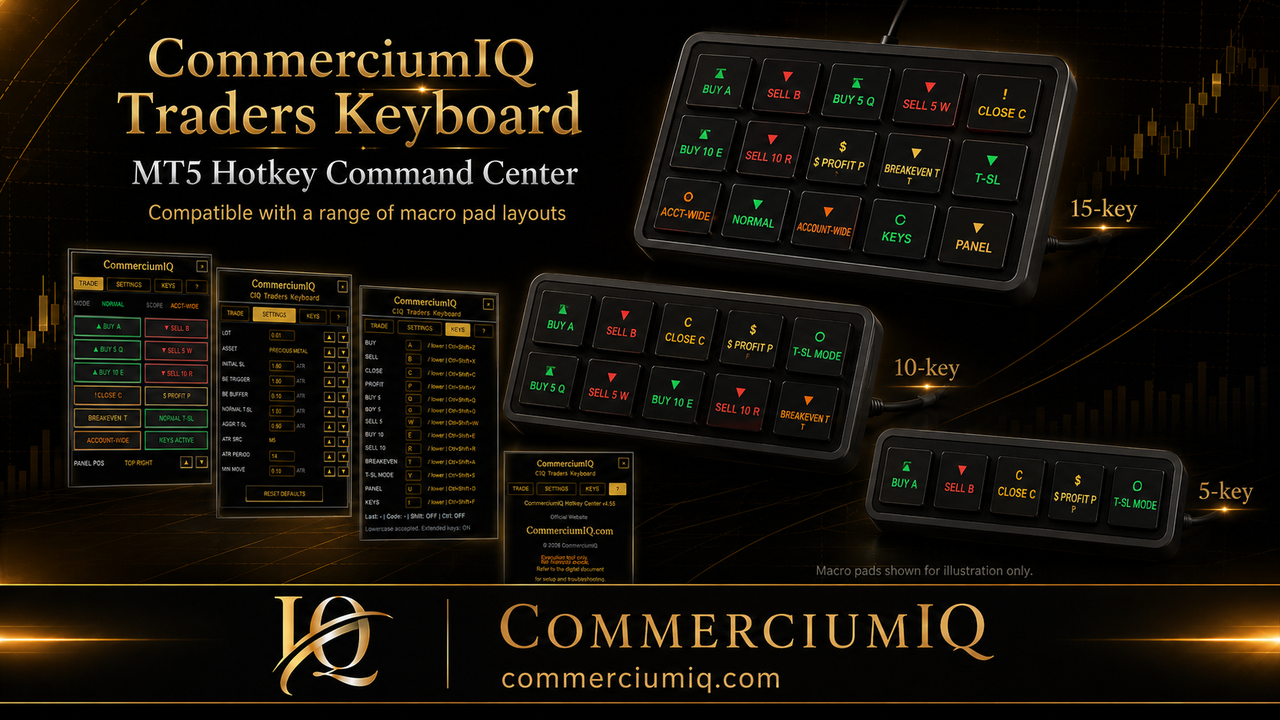
CIQ Traders Keyboard supports a clearer manual process, not reckless speed.
Treat one-click as a final step, not the plan
One-click behavior should be the final step after the account, symbol, volume, and command have already been reviewed. It should not become the entire decision process.
When the click becomes the plan, the trader can skip the checks that prevent wrong-symbol, wrong-size, or wrong-scope errors.
A safer workflow keeps planning and execution separate even when the final input is fast.
Add a pause before dangerous commands
Fast entry commands and close commands should not feel identical to harmless utility actions. A deliberate pause before high-impact commands can reduce mistakes without removing the convenience of the workflow.
This pause can be as simple as reading the command label and confirming the position list before pressing the key.
The point is not to make the workflow slow. The point is to make the dangerous actions intentional.
Test one-click behavior with realistic scenarios
Demo testing should include realistic scenarios, not only a single perfect test. The user should test one open position, multiple open positions, different symbols, profitable and losing positions, and a chart switch.
These scenarios reveal whether the user truly understands what the command affects.
A one-click workflow is not ready until the user can predict the result across more than one simple case.
Avoid making speed the selling point
Speed should not be the main public promise. Faster access can be useful, but the stronger selling point is a clearer manual workflow with labels, scope awareness, and setup guidance.
This distinction avoids encouraging reckless behavior and keeps the guidance educational.
A trust-focused page should explain risks openly before inviting the user to buy.
Final risk-control summary
The user should use one-click-style controls only after the action is understood, the command is tested, and the result can be verified in MT5.
If the command creates uncertainty, the user should remove it from fast access or keep testing in demo.
That final rule applies to beginners and experienced manual traders alike.
Repeat the one-click risk warning
The one-click risk warning should appear wherever users learn or configure the workflow. A new user should understand that faster access requires more deliberate setup, not less.
This is especially important for commands that open, close, or modify exposure. Those commands should be introduced with demo testing, scope review, and a clear expected-result checklist.
Repeating the message across the site helps prevent visitors from treating the product as a speed-only tool.
Final one-click readiness test
The final readiness test is whether the user can explain the action before pressing and verify the result after pressing. If the user cannot do both, the workflow is not ready.
That test applies to ordinary platform buttons, software hotkeys, macro pads, and any command-center interface.
One-click access should be earned by clarity, not assumed because the button is available.