
Key point
An MT5 order management checklist is an operational safety routine for manual traders. It helps confirm the account, symbol, exposure, command scope, and expected after-state before a trade-management action is triggered.
This checklist is not a signal system and it is not a promise of better trading results. It simply reduces avoidable platform mistakes before speed, hotkeys, or macro pad controls are added.
Start with the account mode
The first order-management check is whether the active MT5 terminal is connected to the intended account. Demo, live, prop-firm, and secondary broker accounts can look similar when the trader is moving quickly.
A command should not be trusted until the trader knows where the command is being sent. If the active account is unclear, the safer choice is to pause and use the normal MT5 interface until the context is confirmed.
Confirm the exact broker symbol
The second check is the exact broker symbol shown by MT5. Traders may speak in simple symbols such as XAUUSD, EURUSD, or NAS100, while the broker may display a suffix, prefix, or alternate contract name.
Current-symbol workflows depend on the platform context. The trader should compare the chart title and the open position list before using close, breakeven, trailing, or partial-close commands.
Read the position list before acting
The position list is the source of truth for open exposure. It shows the symbol, size, entry price, stop loss, take profit, current profit or loss, and whether multiple positions exist.
A chart can help with visual context, but the position list confirms what the account actually holds. A checklist should require the trader to read it before using high-impact order-management commands.
Identify the command family
Order management includes different command families. Closing a position, closing profitable positions, moving to breakeven, applying a trailing stop, and partially closing exposure are not the same workflow.
The trader should name the command family before pressing a key. If the command cannot be described clearly, it should not be placed behind a fast shortcut.
Check current-symbol versus broader scope
A current-symbol command should affect only the intended broker symbol. A broader command can affect more positions and therefore deserves a stronger review step.
Scope confusion is one of the easiest ways a helpful tool can become risky. The label, software panel, documentation, and demo-test record should all agree about what the command can touch.
Review position size and remaining exposure
Position size changes the practical effect of every order-management action. Partial close, close profit, and protection adjustments all depend on the existing position state and what exposure will remain afterward.
The checklist should include the expected after-state. The trader should know whether the command is supposed to remove exposure, reduce it, protect it, or leave it unchanged.
Review stop-loss and protection changes
Breakeven and trailing-stop commands should be handled carefully because they modify position protection. The trader should know whether the command uses an entry price, a buffer, a trailing distance, or a broker minimum distance.
If the stop location or broker rule is unclear, the command should be tested in demo before it is trusted in a serious workflow.
Use a before-and-after loop
A strong order-management checklist has two sides. Before the command, the trader confirms account, symbol, position state, command scope, and expected result. After the command, the trader verifies what changed in MT5.
This loop prevents blind repetition. If the after-state does not match the expectation, the trader stops, records the result, and investigates before pressing another key.
Record platform messages
MT5 may show messages related to invalid stops, market closure, trade context, broker distance, disabled trading, or connection problems. These messages matter because they explain why a command did not complete as expected.
A support request is much easier to handle when the trader can provide the broker symbol, command name, account type, product version, and exact platform message.
Keep broad commands slower at first
Broad close commands and account-wide actions should remain deliberately slower until the trader has strong demo evidence. A command with a larger possible effect should not be made effortless too early.
A professional workflow does not turn every action into a hotkey. It chooses which commands deserve fast access and which commands should remain more deliberate.
Connect the checklist to CIQ Traders Keyboard
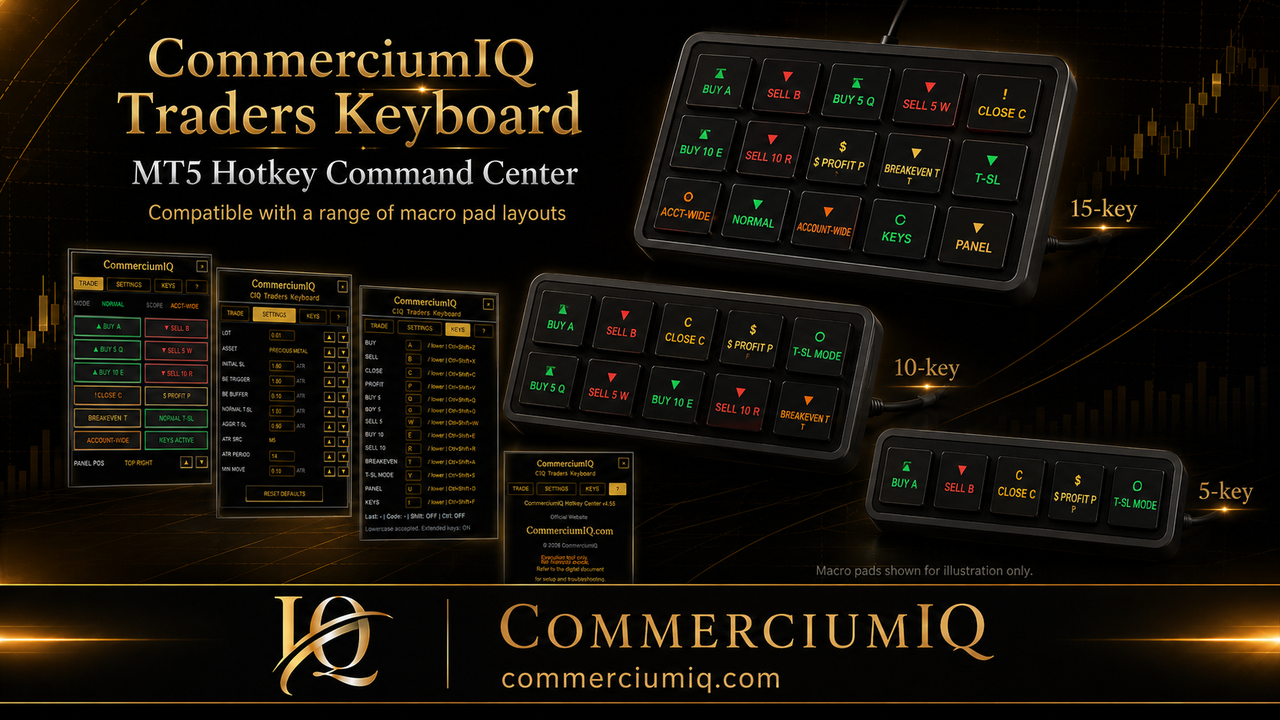
CIQ Traders Keyboard can help organize manual MT5 command access, but it does not replace the trader's responsibility to check account context, command scope, and platform response.
The product should be understood as software workflow support. It can make tested commands easier to reach, but the user still controls the trading decision and risk process.
Final checklist rule
The final order-management rule is simple: confirm account, symbol, position list, command family, command scope, and after-state before relying on a shortcut.
When that routine is written down and tested in demo, order management becomes calmer and more repeatable without pretending that faster access creates better trades.
Order-management drill for one position
A simple drill starts with one small demo position. The trader writes the expected result, uses one order-management command, and then reads the MT5 position list before doing anything else.
For this checklist page, the drill should focus on whether the position changed exactly as expected. If the stop moved, the trader records the new level. If the position closed, the trader confirms which symbol and size were affected.
This drill keeps order management tied to visible platform evidence instead of memory.
Order-management drill for multiple positions
A second drill uses more than one demo position on the same symbol or across different symbols. This shows whether the command is current-symbol scoped, position-specific, or broader than the trader expected.
The important question is not whether the command feels fast. The important question is whether the trader can predict what MT5 will show after the command runs.
If the result is not predictable, the command should stay out of fast access until the setup is clearer.
Checklist example for a close command
A close-command checklist should be written before the command is made fast. The trader confirms the active account, reads the open position list, confirms the broker symbol, and writes which position or symbol should be affected.
After the command runs, the trader checks whether the intended position closed, whether any other position changed, and whether MT5 displayed a warning or rejection message. That after-check matters more than the speed of the key press.
If the result does not match the expected after-state, the command should be removed from fast access until the scope is understood.
Checklist example for a protection command
A protection command deserves a different review. The trader confirms the current stop-loss state, the intended breakeven or trailing behavior, and any broker minimum-distance rule that may affect the command.
The after-state should show the new stop level or confirm that no change occurred. The trader should not assume that a command worked simply because a shortcut was pressed.
This protection-focused checklist keeps order management tied to visible MT5 evidence rather than memory, hope, or repeated clicking.
How to use this checklist
Use this checklist before assigning order-management actions to keyboard shortcuts or macro-pad keys. Compare each item with the actual CIQ Traders Keyboard command map and leave any unclear command unmapped.
Fast access should be limited to commands that have a clear label, a known scope, and a tested MT5 result.