
Key point
A breakeven stop-loss command is a trade-management action, not a profit guarantee. It may move a stop toward an entry-related level, but the final outcome still depends on spread, broker rules, execution conditions, and market movement.
The user should understand what the command is designed to do before assigning it to a hotkey, macro pad, or fast workflow.
What breakeven usually means
In simple terms, breakeven means moving the stop loss to a level near the entry price. Some workflows use exact entry, while others use a small buffer to account for spread or costs.
The specific rule matters. A command that uses an entry-plus-buffer rule is different from one that moves the stop exactly to entry.
The product documentation and label should make the intended behavior clear.
Why a buffer may be used
A small buffer can help account for costs or spread, but it does not remove the remaining trade risk. The correct buffer depends on the instrument, broker, and user preference.
A user should not assume that a breakeven label means the worst possible result is exactly zero.
This is why the command should be tested with the user's actual broker symbols and normal lot-size environment in demo.
Broker constraints can block the move
MT5 and broker rules may prevent a stop from being placed too close to current price. If the market has not moved far enough, a breakeven command may fail or behave differently than expected.
That result is not always a software bug. It may be a minimum-stop-distance, freeze-level, or platform-state issue.
The user should record any platform message that appears during the demo test.
Current-symbol scope for breakeven
A breakeven command should clearly state whether it applies to the current symbol, selected position, or a broader group. This is especially important when several positions are open.
The user should test a scenario with one position on the active symbol and another position on a different symbol.
After the command runs, the position list should show exactly which stops changed.
Multiple positions need extra review
When multiple positions exist on the same symbol, breakeven behavior may need a rule for each position. The user should know whether each position is handled separately or whether the command targets only a selected trade.
Different entries can create different breakeven levels.
The test should include more than one position if the user plans to trade that way.
Do not place BE beside dangerous commands
A breakeven key is less final than a close-all key, but it still modifies protection. It should not be placed in a confusing area of the macro pad or beside unrelated high-impact commands.
The label should be short and specific, such as BE + Buffer if that matches the workflow.
The user should know whether the command is current-symbol scoped before pressing it quickly.
What to verify after pressing BE
After pressing a breakeven command, the user should review the stop-loss value in the MT5 position list or order line. The user should check whether the stop moved, whether the new level is what they expected, and whether any platform message appeared.
If the stop did not move, the user should slow down and inspect platform conditions instead of repeatedly pressing the key.
The result should be added to the setup record.
When breakeven can be harmful
Moving a stop too early can remove a trade before the user's idea has enough room to develop. This is a strategy and risk-management decision, not something the software can decide for the user.
The product can make the command easier to reach, but it cannot decide when breakeven is appropriate.
The content should keep that boundary clear.
Demo test for breakeven
A useful breakeven demo test starts with a small position that has moved far enough to allow a stop adjustment. The user records entry price, expected breakeven level, actual stop level after the command, and any message shown by MT5.
The test should be repeated with the intended symbol class, because gold, forex pairs, and indices can behave differently.
A passing test means the result is predictable, not merely that the command produced some change.
How breakeven fits the trade-management cluster
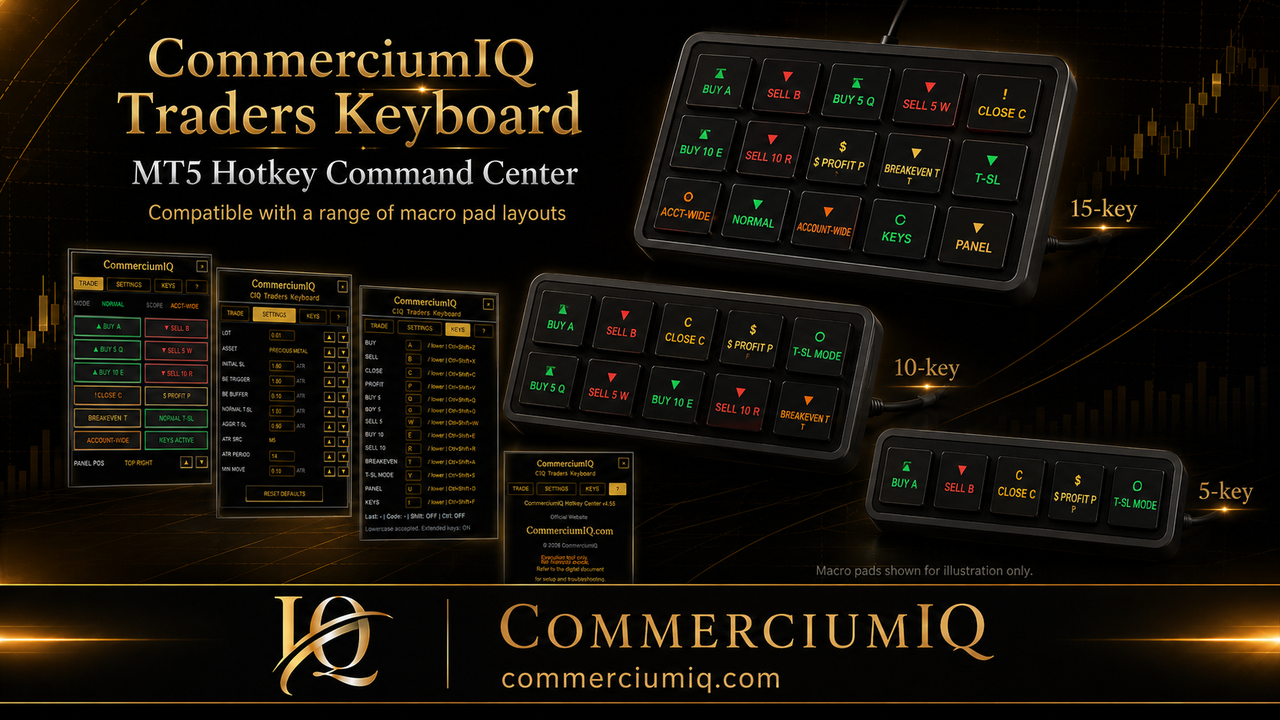
Breakeven belongs beside current-symbol scope, close-command scope, and trailing-stop content. All of these pages teach the same principle: a command needs a name, a boundary, and a demo-tested result.
Related pages should guide readers between these actions so they can understand the full trade-management workflow.
That learning path is more useful than isolated pages with repeated generic explanations.
Final breakeven rule
A breakeven command should be mapped only after the user understands the rule, buffer, broker constraints, and scope.
If the command result cannot be predicted in demo, it should not be trusted in a fast workflow.
Breakeven is helpful only when it supports a risk plan the user already understands.
Breakeven should be part of a written risk plan
A breakeven command is most useful when the user already has a written rule for when the stop should move. Without that rule, fast access can encourage the trader to adjust stops emotionally rather than intentionally.
The written rule can be simple. It might describe the minimum movement required, the buffer used, and the condition that prevents the command from being used.
The software can support the action, but the decision still belongs to the user.
Test breakeven around broker limits
A breakeven test should include a case where price has moved enough for the stop to be accepted and a case where price is too close for the stop change. That second case teaches the user what a blocked or rejected move looks like in the platform.
Knowing the failure mode is useful. It prevents the user from pressing repeatedly or assuming the wrong command was used.
The setup notes should mention broker messages, minimum distance behavior, and any symbol-specific observations.
Avoid treating BE as a universal safety button
Breakeven can reduce one kind of risk while creating another kind of trade-management problem. If the stop is moved too soon, normal price fluctuation can remove the position before the original idea has time to develop.
That is a strategy decision, not a software decision. The product should make the command clearer, not decide when the command is wise.
This boundary supports workflow education while keeping product claims accurate and responsible.
Final breakeven setup check
Before a breakeven command is placed on a fast control, the user should confirm the buffer rule, the eligible positions, the current-symbol boundary, and the platform message shown when the stop cannot be moved.
That final setup check keeps breakeven as a deliberate protection action rather than a vague safety button.